Английский
 Упрощённый китайский
 Испанский
 Французский
 Немецкий
 Русский
 Португальский
 Итальянский
 Японский язык
 Корейский язык
 Арабский
 Турецкий язык
 Вьетнамский язык
 Тайский
 Индонезия
 Малайский

When fitted wardrobes, high storage cabinets, and custom joinery are installed in modern residential and commercial properties, few issues cause more frustration than mid-term structural deformation—specifically, floor-to-ceiling side panels bowing, wardrobe doors misaligning, or heavy shelving sagging.
Concealed structural components—such as tall carcass side panels, backboards, and interior load-bearing shelves—remain hidden behind decorative surfaces, yet they form the backbone of the entire cabinet system. During material selection, ДСП (particle board) and OSB (Oriented Strand Board) are standard options. Which material truly keeps concealed cabinets straight and stable over time? Here is a practical engineering guide to help you choose the right material for your next project.
1. Why Traditional Chipboard Warps in Tall Cabinet Units
Project contractors and joinery buyers often wonder: Why do tall wardrobe units constructed with high density chipboard panels or water resistant chipboard sheets still bow after experiencing a few seasonal changes in humidity?
The primary reason comes down to internal particle geometry and how the board is constructed:
- Physical Limits of Chipboard: Traditional Chipboard is made by compressing small wood chips, sawdust, and adhesive in a random mixture. Because there are no continuous wood fibers, the internal board structure lacks inherent directional strength. When ambient moisture fluctuates, water penetrates fine voids, causing uneven expansion that manifests as visible bowing.
- The “Interlocking Mesh” of OSB: OSB utilizes long wood strands (40–100 mm long) arranged in cross-oriented layers—longitudinal on the outer faces and transverse in the core. Like a woven basket, this cross-laminated structure neutralizes internal forces in all directions, keeping long panels flat even under continuous vertical load.
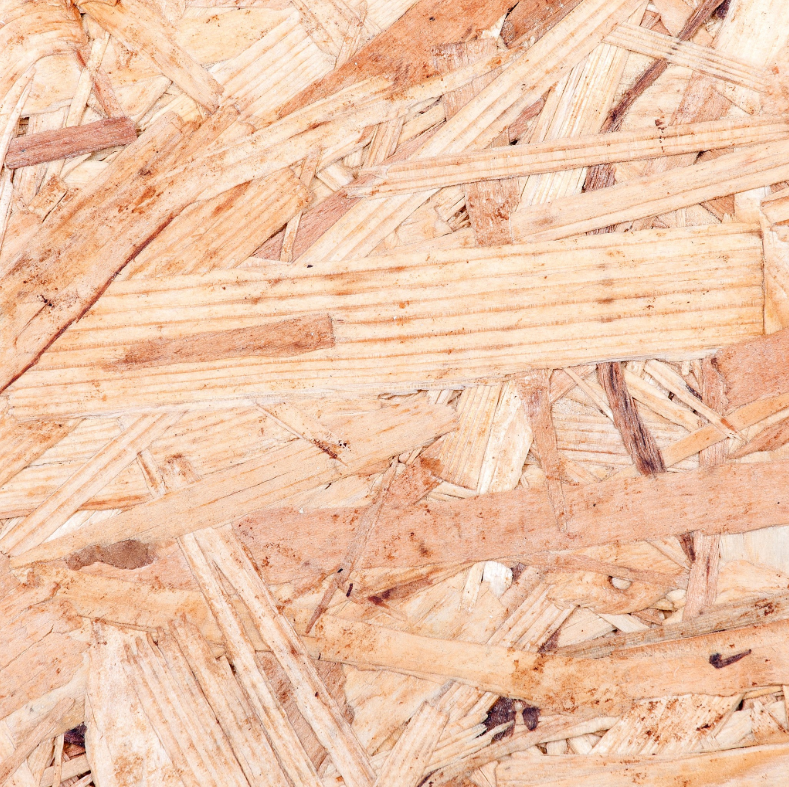
2. Head-to-Head Performance Comparison: OSB vs Chipboard
When sourcing engineered chipboard for furniture versus OSB panels for commercial or residential joinery, consider these 5 structural performance metrics:
| Performance Metric | OSB (Oriented Strand Board) | Traditional Chipboard (Particle Board) |
| Internal Material Structure | Large cross-oriented wood strands in layered mesh | Random mixture of small particles and sawdust |
| Long-Term Warp Resistance | Interlocking strands balance stress; stays flat over long spans | Lacks directional fibers; prone to creeping and bowing |
| Screw Holding & Re-assembly | Wood strands grip screws tightly; supports repeated disassembly | Relies on glue-bonded dust; screw threads easily strip |
| Moisture & Edge Swelling | Strands fully coated in resin; low thickness swelling rate | Fine particles absorb moisture like a sponge; edges swell |
| Environmental & Binder Profile | Structural integrity comes from strand geometry; low binder ratio | Requires higher resin volume to bind fine dust particles |
3. Practical Field Scenarios & Engineering Tips
Scenario A: 2.8m Floor-to-Ceiling Wardrobe Side Panels
Floor-to-ceiling cabinetry without breaklines is a dominant design trend in contemporary luxury apartments and private villas.
- Engineering Tip: Using standard melamine faced chipboard panels for 2.8m unsupported side panels often leads to outward curvature over 12–24 months due to gravity and door hinge tension.
- Recommendation: Specify OSB for tall carcass side panels and main structural frames. Its mechanical rigidity ensures side walls remain straight and square year after year.
Scenario B: Moisture-Prone Zones (Kitchen Sink Base Units & Basements)
Hidden carcasses beneath kitchen sinks or storage cabinets in basements face continuous ambient humidity and occasional moisture exposure.
- Engineering Tip: If edgebanding on standard chipboard gets scraped or worn, ambient moisture rapidly travels through tiny wood particles, leading to permanent edge swelling.
- Recommendation: OSB’s dense, overlapping strand structure blocks fast water infiltration paths. When combined with PUR edgebanding, OSB carcasses easily handle high-humidity microclimates.
4. Frequently Asked Questions (FAQ)
Q1: Does OSB have a rough surface? Can it achieve a smooth decorative finish?
A: Modern calibrated OSB panels are precision-sanded in the factory to create a flat, uniform surface. They readily accept melamine papers, decorative laminates, and wood veneers, yielding smooth interior cabinet finishes while meeting strict no-added-formaldehyde (such as MDI resin) eco-standards.
Q2: Is it cost-effective to mix Chipboard and OSB on the same project?
A: Yes, this hybrid specification offers the best balance of cost and performance:
- Use Chipboard: For small, non-load-bearing components like short drawer boxes or minor internal dividers.
- Use OSB: For tall carcass side panels, continuous backboards, and long-span load-bearing shelves that define the structural integrity of the cabinet.
5. Structural Board & Custom Joinery Solutions
For commercial fit-outs, hospitality developments, and high-end residential joinery projects, Yajuwood provides a comprehensive range of structural OSB panels, engineered boards, and custom furniture materials tailored to different climate conditions. We help contractors, furniture manufacturers, and importers optimize material schedules, minimize structural callbacks, and deliver joinery built to last.