ภาษาอังกฤษ
 ภาษาจีนตัวอักษรแบบย่อ
 ภาษาสเปน
 ภาษาฝรั่งเศส
 ภาษาเยอรมัน
 ภาษารัสเซีย
 ภาษาโปรตุเกส
 ภาษาอิตาลี
 ภาษาญี่ปุ่น
 ภาษาเกาหลี
 ภาษาอาหรับ
 ภาษาตุรกี
 ภาษาเวียดนาม
 ไทย
 อินโดนีเซีย
 มาเลย์


or furniture manufacturers and project contractors sourcing ไม้อัดเมลามีน globally, post-shipment quality issues remain a top source of customer complaints. Containers arrive after weeks of ocean freight with peeling edge banding; workshop cutting leaves jagged, chipped edges; and panels develop edge cracks months after installation. Most importers immediately blame poor panel quality—but industry data shows that 90% of these failures stem not from the melamine face or plywood core itself, but from uncontrolled physical compatibility between edge banding and the substrate.
1. Root Causes: 4 Key Drivers of Edge Chipping and Cracking
Many importers cycle through supplier after supplier without reducing complaint rates, because they only inspect surface appearance and ignore the matching logic between substrate, edge banding, and processing.
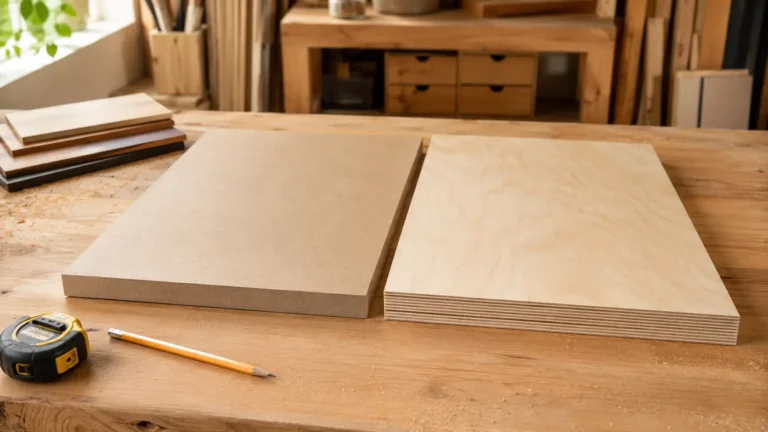
- Uneven Substrate Density: Internal Voids Cause Stress Concentration During Cutting Low-quality plywood is manufactured with wide veneer gaps and inconsistent glue application, often resulting in density variation over 10% across the panel. When cut, stress cannot distribute evenly through the board. The hard melamine resin overlay lacks stable internal support, leading to jagged, chipped edges that increase sanding labor and weaken edge banding adhesion.
- Edge Banding Material Mismatch: Thermal Expansion Differences Cause Delamination This is the most common failure mode in cross-ocean shipping. Many importers choose standard PVC edge banding to cut costs, but its thermal expansion coefficient differs significantly from plywood substrate. During transit, container temperatures can swing by 70°C — from -10°C in cold zones to 60°C in tropical ports. Repeated dimensional stress wears on the bond line, eventually causing edge banding peel-off and panel edge cracking. Thickness mismatch amplifies the problem: too thin offers no impact protection, while too thick magnifies deformation stress.
- Adhesive-Temperature Misalignment: Hot Melt Glue Type vs. Operating Environment Two main hot melt adhesives are used for edge banding, with very different use cases: EVA glue has a low melting point and easy application, but only performs well in mild, dry environments. PUR adhesive delivers superior heat and moisture resistance for humid or high-variation climates, but requires precise application temperatures and pressure. Many importers source glue separately, matching it to neither their destination climate nor workshop conditions, resulting in premature bond failure.
- Incorrect Machinery Settings: Saw and Edge Bander Parameters Clash with Panel Hardness Melamine overlay has a much harder resin surface than solid wood, and requires specifically tuned processing parameters. If saw blade RPM is too low, or tooth rake angle is incorrect, the resin layer will chip instead of shearing cleanly. On edge banders, default glue volume, roller pressure, and feed speed settings for standard wood panels create uneven glue lines and weak bonds that fail over time.
2. The Solution: Build a Gold-Standard Substrate-Edge Banding-Process Loop
Solving chipping and cracking requires unified matching standards across substrate manufacturing, edge banding selection, and processing — not just upgrading one component. The table below shows recommended edge banding to substrate thickness ratios for different applications:
| Substrate Thickness | Standard Cabinetry Recommendation | High-Stress / Humid Environment Recommendation | Typical Applications |
|---|---|---|---|
| 9mm Shelf Panels | 0.6mm PVC Edge Banding | 0.8mm ABS Edge Banding | Wardrobe shelves, storage units |
| 15mm Side Panels | 1.0mm ABS Edge Banding | 1.5mm ABS Edge Banding | Standard cabinet sides, interior doors |
| 18mm Carcass Panels | 1.5mm ABS Edge Banding | 2.0mm ABS Edge Banding | Bathroom vanities, laundry cabinets, humid-zone carcasses |
| 25mm Structural Panels | 2.0mm ABS Edge Banding | 2.0mm Heavy-Duty ABS Edge Banding | Load-bearing countertops, high-stress construction components |
Factory Quality Control Key Points
ในฐานะผู้เชี่ยวชาญ melamine plywood manufacturer and supplier, Yajuwood controls compatibility across the entire production chain to help overseas customers drastically reduce post-sales quality risks:
- Precision-controlled melamine impregnation cure rate: We stabilize overlay cure rate between 85% and 90%, balancing surface abrasion resistance with cutting flexibility to reduce chipping at the material level.
- CNC cutting + temperature-controlled edge banding integration: Our CNC panel saws automatically adjust blade speed and feed rate based on panel density. Edge banding stations feature closed-loop temperature control, matching glue temperature and roller pressure to substrate and edge banding type for consistent bond strength.
- Strict substrate homogeneity control: Every batch is tested for density variation, held within ±5% to ensure uniform internal structure and predictable cutting and bonding performance.
3. B2B Sourcing Guide: Don’t Only Inspect Surface Quality on Arrival
Most importers only test surface abrasion resistance during incoming quality control — this is not enough to predict future edge banding failure. For bulk orders, we recommend adding two critical tests to your inspection protocol:
- Hot water edge peel test: Submerge edge-banded samples in 60°C water for 2 hours. Any peeling, lifting, or discoloration at the bond line indicates poor compatibility in high-humidity environments.
- Thermal cycling test: Cycle samples between -10°C and 60°C for 3 full cycles to simulate extreme temperature swings during ocean shipping, and verify dimensional compatibility between edge banding and substrate.
Every batch of melamine plywood from Yajuwood undergoes full edge banding compatibility testing and thermal cycle testing before shipment, with test reports included with every container. This helps overseas buyers catch issues early and reduce costs from customer complaints and returns.

4. Frequently Asked Questions (FAQ)
Q1: Why does melamine plywood chip more when cut in winter than summer?
Cold temperatures increase brittleness in the melamine resin overlay and reduce flexibility in the wood fibers of the substrate. If cutting equipment uses the same blade speed and feed rate settings as summer, the hard resin layer will chip instead of shearing cleanly. For cold workshop environments, increase saw blade RPM, reduce feed speed, and prioritize more flexible ABS edge banding for better impact resistance.
Q2: How can I quickly check edge banding and substrate compatibility when importing melamine plywood?
Two simple on-site checks can help you screen poor-quality batches fast: First, inspect the cut edge: a substrate with uniform density and no visible voids provides more bonding surface area and creates a stronger, more stable bond with edge banding. Second, test edge banding flexibility: bend the edge banding 180 degrees. If the bend whitens or cracks, the material is too brittle to match the dimensional movement of plywood, and will perform poorly in regions with large temperature swings. For bulk orders, always request thermal cycling test reports from your supplier to confirm long-term bond stability.